
Couples therapy after an affair — Melbourne and the Mornington Peninsula
A private and carefully held space for couples in the weeks and months after infidelity, where what happened can be told properly and looked at slowly.
A sentence is enough, and it can come from either of you. Every enquiry receives a personal reply within one business day.
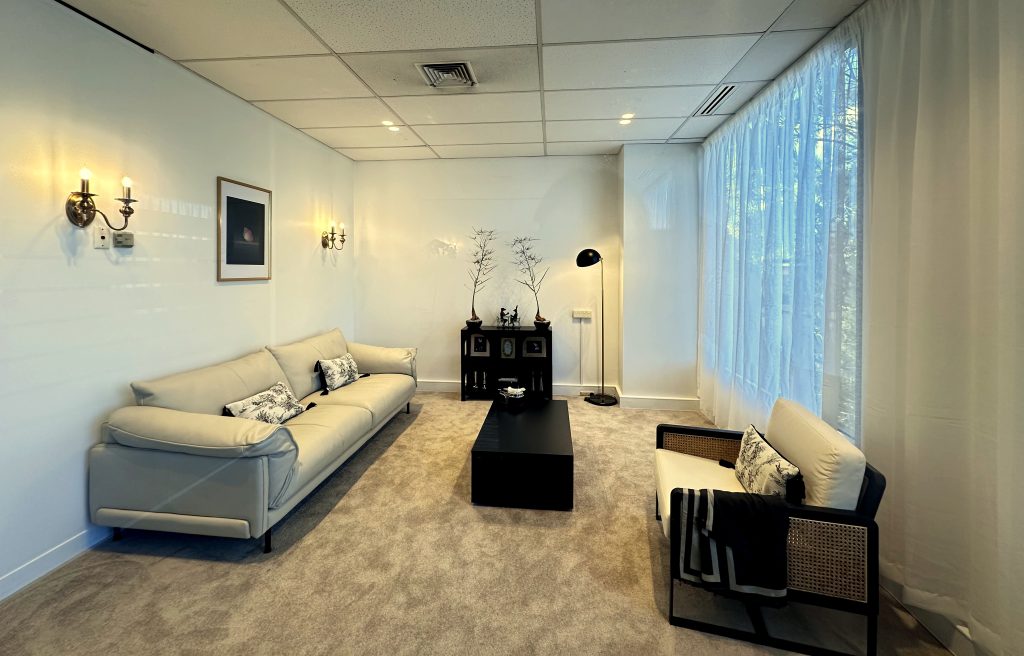
There is a particular quality to the days after an affair is discovered. Time behaves oddly. The same three questions arrive again at two in the morning and are no nearer an answer by breakfast. One of you cannot stop asking. The other cannot find a way to answer that does not appear to make it worse.
If that is where you are, you are not handling it badly. That is what the first weeks after a discovery are like, and it is not a sign of anything about the two of you.
Therapy Atelier is a couples-only practice in Mornington, working also in Melbourne and online. A great deal of what happens in these rooms concerns infidelity — the discovery, the disclosure that follows it, and the long and particular labour of trust repair. Couples often arrive here having searched for marriage counselling after an affair, or for someone who works with betrayal specifically rather than as one item on a longer list.
You do not need to have decided anything before you come. Most couples have not.
The first session, after discovery
The first session runs ninety minutes, and it is quieter than most people expect.
It is not where the whole account is given. A full disclosure, where a couple wants one, is prepared for and takes place later, on terms both of you have agreed in advance. The first session has a smaller and more useful task: to find out what state each of you is actually in, what is already known, what is being asked, and what has been happening between you since the discovery.
Some of that will be familiar — the checking, the sleeplessness, the sudden need to know one detail at eleven at night. Some of it will not yet have been said aloud by either of you. Both belong in the room. Nobody is asked to arrive composed.
You should leave with three things. A clearer sense of what is actually in front of you. An agreement about how the coming weeks will be handled at home. And an honest answer about whether this is the right room — if it is not, you will be told so plainly.
Disclosure is not interrogation
The betrayed partner almost always wants to know more, and is often told, by well-meaning people, that they ought to stop asking. That advice misunderstands what the asking is for. After a betrayal the mind is trying to rebuild a version of the past it can trust, and until it has one it will keep going back for the missing pieces. This is not morbid curiosity. It is repair work being attempted without any tools.
The unfaithful partner, meanwhile, usually believes that the kindest course is to say as little as possible. That instinct is understandable and it is almost always wrong. Truth released in instalments does more damage than truth told once. Every detail that surfaces later resets the clock, and the betrayed partner learns, correctly, that what they have been given is only what could not be withheld.
The difference between disclosure and interrogation is not the content. It is the structure. Interrogation happens at midnight, without limit, when both people are exhausted and neither can stop. Disclosure happens by arrangement — questions considered beforehand, a therapist in the room, an agreement about what will be asked and what will not, and a clear beginning and end. It is harder in the hour. It is very much easier in the month that follows.
You do not have to know yet whether you are staying
You may want the relationship. You may be certain that you do not. You may want it on Tuesday and be unable to imagine it on Wednesday. All of that is ordinary after an affair, and none of it disqualifies you from the work.
Ambivalence is not an obstacle here. For a period it is the actual subject. A decision of this size deserves to be made with both people present and thinking clearly, which is not the state either of you is in during the first fortnight.
What this room will not do is arrive at reconciliation by momentum, because staying was the least frightening option available on the day. Nor will it steer you towards separating. There is no preferred outcome here. There is only a preferred way of arriving at one.
How repair actually works
What is often called affair recovery is not a single conversation, and it does not move in a straight line. It moves in a sequence, and the sequence cannot be reordered or hurried.
The first part is atonement. The partner who had the affair has to be able to hear the full weight of what it has cost, more than once, without defending, explaining, or asking how long this is going to go on. It is the least comfortable stretch of the work and it is the one that cannot be skipped.
The second is attunement. The conversation moves from what happened to what had been happening — in the relationship, and in each of you, over the years before. This is not a search for who is to blame for the affair. Responsibility for an affair belongs to the person who had it. But the relationship it grew inside has its own history, and both people usually have something to learn from it.
The third is attachment, and it arrives later than couples expect. Trust in the ordinary daily sense returns first; physical and erotic closeness comes after it, on its own timetable, and cannot be willed.
Trust is not restored by a promise. It is restored by a long accumulation of small, verifiable, unremarkable consistencies, noticed by the partner who is watching for them. Rupture and repair is the ordinary rhythm of every close relationship. What an affair does is exhaust a couple’s confidence that the repair will come at all. Rebuilding that confidence, slowly and in the presence of both people, is most of the work.
Can the relationship survive this?
The honest answer is that I do not know, and anyone who tells you at the outset that they do is selling you something.
What can be said is this. Some couples who come after an affair rebuild something they later describe as more honest than what they had before. Some conclude that they will not continue, and manage that with more clarity and less damage than they would have found alone — which, where there are children, is not a small thing. Others remain undecided for longer than they wanted to be. No form of therapy can promise you which of those you will be, and this practice does not.
What the work offers is narrower than a promise and rather more useful. Whichever of those you arrive at, you will have arrived at it having genuinely looked — rather than by exhaustion, by drift, or because the truth was never fully told.
What this work requires
One condition, and it is easier said now than later. The affair must have ended.
Couples work cannot do anything useful while another relationship is still live and concealed. That is not a moral position; it is a practical one. The room would be attempting to rebuild trust around a gap it cannot see, and the betrayed partner would be asked to do the most exposing work of their life on false information. The practice declines intensives, and will pause weekly work, where an affair is continuing and hidden. If that is the situation, it is far better said before the work begins than discovered in the middle of it.
Couples therapy is also not the right form of help where there is ongoing violence or coercive control. In those circumstances the appropriate support is individual and specialist, and the practice will say so and help point the way. 1800RESPECT — 1800 737 732 — is the national family violence and sexual assault line.
One further boundary, stated plainly. Therapy Atelier sees couples only. Where one partner also needs individual therapy alongside this work — after an affair that is common, and often sensible — the practice will help you find it, but it is not provided here.
When weekly sessions are too slow
Weekly therapy has a rhythm. You open something, work at it for ninety minutes, then close it and carry it for six days. In the months after a discovery, those six days are not neutral. They are long enough for the conversation to be reopened badly at home, and for the ground gained on Tuesday to be lost again by Thursday.
An intensive removes the interval. The work runs across consecutive days — three, or five — in a single block, with the same two people and the same therapist. A disclosure can be prepared, held and properly finished inside one week rather than spread across two months of Tuesday evenings. Difficult material can be taken to its end rather than parked at the point where it hurts most. Elsewhere in Australia you will see this format called marathon couples therapy; the shape is the same.
Each intensive begins with Gottman relationship assessments completed online and read before the first day, and a proper conversation on the first morning, which together confirm that the format is the right one for you. The days combine joint and individual hours. Afterwards there is a written integration document and two follow-up sessions, because the fortnight after an intensive matters as much as the days themselves. Held on the Mornington Peninsula, or online.
Fees
- Ninety-minute couples session — AUD 350.
- Three-day intensive — AUD 5,800; fifteen hours across three consecutive days.
- Five-day intensive — AUD 7,800; twenty-five hours across five consecutive days.
Intensive fees include the Gottman assessment beforehand, the integration document, the two follow-up sessions, and lunch and refreshments on each day.
Psychotherapy of this kind is GST-free. Couples therapy is not covered by Medicare in Australia; the fees page explains.
Who you would be working with
Therapy Atelier is led by Tumee Hugginson, psychotherapist and couples therapist. She holds an MA in Clinical Psychology, is trained to Level 3 in the Gottman Method, works in Emotionally Focused Therapy, and brings a Jungian and psychodynamic training to the parts of this work that sit below the level of communication.
The practice is deliberately small. The enquiry reaches her, the sessions are hers, and there is no intake team between you and the work.
How to begin
An enquiry goes to Tumee directly. It does not need to explain anything and it does not need to be composed. A sentence is enough, and it can come from either of you.
The reply sets out what a first session would involve, what the practice offers and what it does not. If another kind of help would serve you better, that is said plainly rather than politely avoided. Nothing is booked at the point of enquiring.
Or call 03 5939 4984. In person at Suite 4, 346 Main Street, Mornington VIC 3931 — on the Mornington Peninsula, in Melbourne, or online.
You can also read about couples therapy, couples intensives, marathon couples therapy, when one of you is unsure, intercultural couples, or the practice in Melbourne and Mornington.